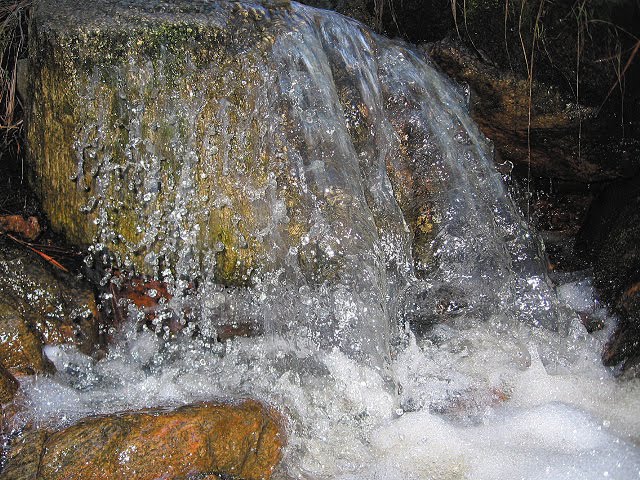
Thursday, June 17, 2010

Appreciating Summer

I'm a winter person. I've been working on appreciating summer. This work is easier at the crepuscular times of the day, and at night, under the stars. I went out this morning just after sunrise and made my way up Two-Doe Mountain, one of my regular summer early-morning haunts. I tracked a doe and fawn for half an hour and lost them at this stream crossing.
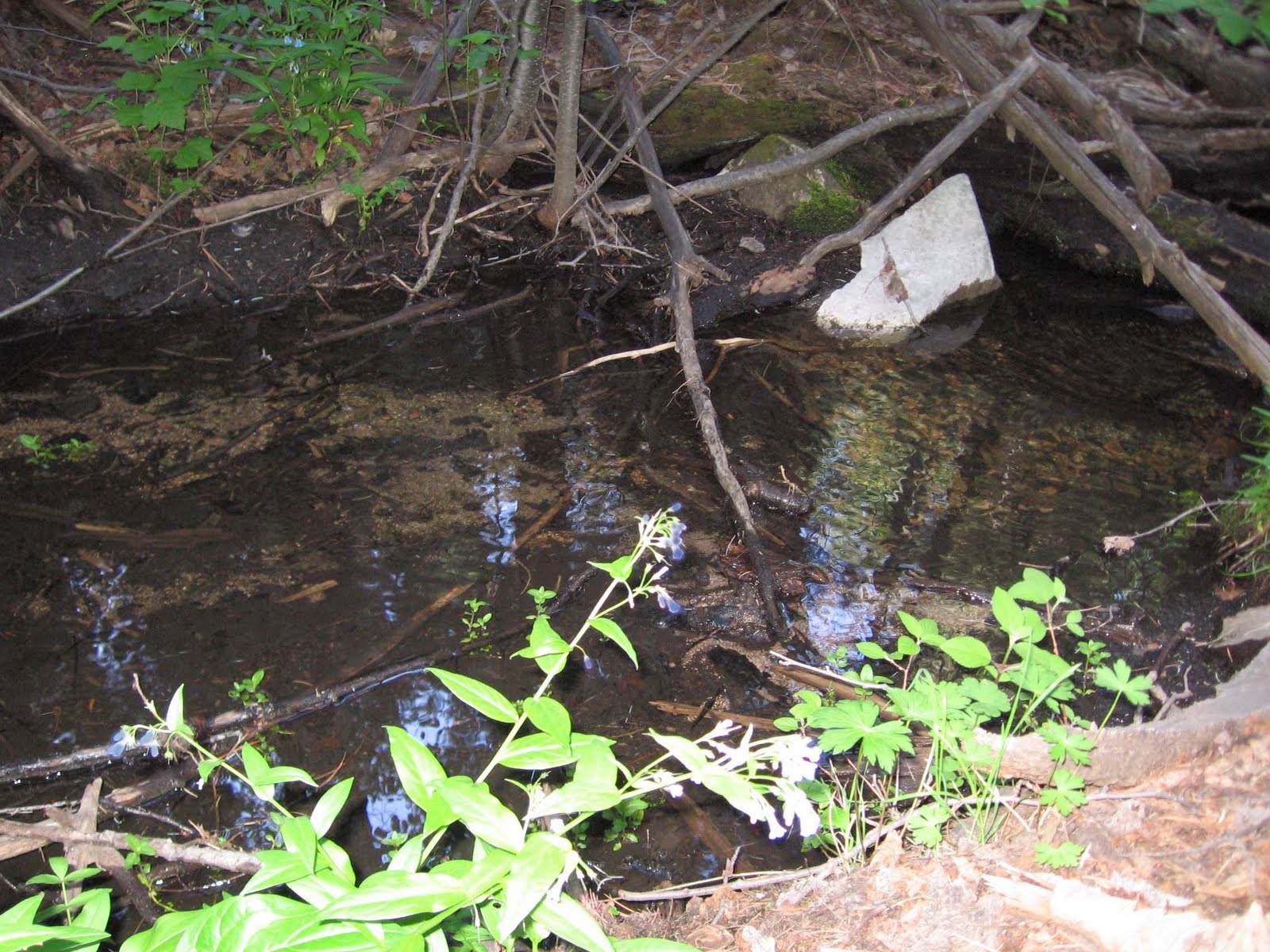
It was a pleasant place to be led to.  It had everything a doe and fawn require: water, food, and dense cover. That last item can be hard to find in the Southwest.

In order to better appreciate summer, I took my camera along to record what inspires me.  Deer, of course. I follow them even when I am not trying to, or trying not to. But deer are for all seasons.  I find magic in snow, but there is inspiration in summer. Here's a shortlist, all shot this morning.
Water
Mountains, and a certain summer color of sky.  Sam Scott, whose artwork and writing you should know if you don't, taught me that the eye sees the three primary colors, and, when one is absent, adds it.  He talks of seasonal color palettes.  On late spring/almost summer mornings like today,  the eye adds a hint of red/magenta along the ridgetops.
Flora.
Animal homes.
Land art created by the elements. 

This lightning-killed tree is a painting waiting to happen.   It's also a home to more living beings than it was when it was alive. 

I was thinking yesterday about monumental land art like Spiral Jetty, corn mazes, etc.  While there is something there to appreciate, they are monuments to ego, as is, perhaps, all art that is not temporary.  When land art is created by the elements, it is without ego.  Perhaps that's the definition of magical.  But then my eye sees it, and I want to recreate it as a painting, a monument to my ego.  Ha!   

Friday, June 11, 2010

Rabbits

After a 5-week hiatus from running and walking, due to a strange little injury, I went out early this morning for a hike. It was glorious (before the 95 degree heat). I revisited one of the waterfalls pictured in my last post, now dry.

There is still a trickle of water in Bear Canyon. As I walked through tall grasses next to a stream, a baby rabbit stopped in its tracks. I did the same, and sat down. There we were for 20 minutes, joined by a horned lizard and a white butterfly. At first, the rabbit demonstrated its skill at appearing less and less visible without moving a muscle. It appeared to melt into the earth. Then it relaxed and started eating grass.

The last rabbit I saw stood beside a road, dazed, with a huge bloody eye, likely slashed by a raptor. I picked it up and drove for an hour to the wildlife hospital, where, the last I heard, it was recovering. Raptors occasionally blind their prey before the kill. That rabbit's eye has been in my dreams and waking mind ever since. It was invigorating to see a young, healthy, two-eyed rabbit, and lovely to spend twenty minutes with it. 

Sooner or later, a one-eyed rabbit will appear in one of my paintings, perhaps only in a form recognizable to me, and perhaps in the company of a rabbit kit, a horned lizard, and a white butterfly.

Wednesday, April 28, 2010

Snowmelt Runoff Art

Most of the snow is gone, but the land is still exhibiting some dynamic art.  Follow almost any stream far enough this spring, and it will reveal a waterfall.   In this desert, that is a small miracle.

Monday, March 29, 2010

Spring Redux

I dusted off my bike and went for a ride yesterday. This morning I went for a run up a favorite ridge to check the runoff in several streams.  Who can resist the allure of a heart-shaped rock?  It is going to be a wonderfully wet spring in this high alpine desert.  There has been so much snow that I've been skiing all winter, not running; hence, I'm experiencing that run over by a truck feeling that comes from calling upon a whole different set of muscles.

I found bear and mountain lion tracks near the trailhead/parking lot. With the lion, there appeared to be a kitten.  It's possible, since cougars can go into estrous at any time of the year, like humans, rather than seasonally, like most other mammals. Tracks are hard to read in melting snow, so I reserve judgment. It is definitely an area that has been a cougar's territory for years; of that I am certain. I've seen plenty of signs.

Bears are emerging from hibernation, with cubs.  I saw signs everywhere of them digging like mad to uncover insects to eat. Imagine the appetite you'd work up in 3-4 months. It seems mercilessly ironic that early spring is the time when forest animals starve to death in harsh climates. They manage against the odds to survive a brutal winter, and then, when the sun is shining, the birds singing, the streams flowing, and temperatures rising, they starve. Spring may have arrived, but there is little to eat  for herbivores, omnivores, and, the carnivores who hunt them. All have severely depleted the fat reserves with which they began the winter. I am offering prayers that all beings find enough to eat.
At least one coyote family I've been watching looks reasonably well fed. They are in my neighborhood, in the foothills. We've been crossing paths often lately. I only recently learned that coyotes live in family units, much as we do, not packs. I assume that the small group I've been seeing is a mother, father, and perhaps a yearling from last spring, and that there are probably pups in a den nearby. I'm not going looking for the den. I don't want to be the stressor that causes them to move.  I'm pretty sure of its general location, from the sightings and the howling.

I visited a nearby beaver pond the other day and saw that they, too, made it through the winter. Likely there are kits in the lodge.

I haven't seen any deer yet this spring, but I saw signs this morning that they are heading up into their summer territory, much of which is still covered with hard-pack snow and thus largely out of bounds for me. The deer and other forest animals must treasure this time, before the trails are crawling with two-legs.

I have a problem painting hanging on the studio wall. It is not going where I thought it was, and it is not offering up any guidance re: where it is going, so I suppose it is time to give it a little rest. Perhaps I shall begin a painting that is rich in the greens that I want the deer and bears to find in the forest.

Meanwhile, I am still driving around with my gaiters and yak trax in the trunk, hoping for one or two more good snows.  It looks as though we might see one this weekend, at least in the high peaks.

Monday, March 22, 2010

Spring

Accepting that spring has arrived is always a bit rough for me.  I love the snow so much that I get attached to it.  But every year there is a day when I acknowledge that spring is actually here, and I start loving it.  Today was that day.  I went for a hike with my nine year old daughter on what just might be my favorite mountain.  The air was fresh and clean.  We moved over deep soft-packed snow, gingerly trying to stay on top of it, and invariably punching holes in it. Carmen got stuck when she took a high route over the snow-covered roots of a huge fallen pine.  She broke through up to her chest and was held in place by the roots.  I had to pull her out.  The photo above is of our destination, a waterfall that has begun to thaw and flow.  Nothing like the raging runoff we'll experience in the coming weeks, but the falls have broken through the snow.   We'll get another couple of snow storms, no doubt--that's spring in the southern Rockies.                                        
                                       
The steady drip of melting snow, and bobcat sign, are everywhere. I'm concerned about the latter.  Just above the falls is a fawn birthing area. Some of the deer have wintered over and others will return soon to give birth.
Even in this steep, shady box canyon, the south facing upper walls are bereft of snow, and the lower walls are warming fast.    
                                      
No, Andy Goldsworthy has not been running around the Sangre de Cristo Mountains.  This snow spiral was created by gravity alone.  These natural sculptures occur when snow falls off a tree on a slope and rolls down, picking up more snow as it goes.  This one is old and its edges have been softened by the freeze/thaw cycle.  When new, snow spirals are often perfectly symmetrical geometric forms.   They surface in my dreams and my paintings.   

Sand Skiing

I found a couple of photos from that sand skiing expedition that I mentioned in the last post (March 15).  Alamosa, Colorado, 1987.   

Monday, March 15, 2010

Diebenkorn in New Mexico

This morning there was a crash or an avalanche or something on the ski basin road. I hope no one was hurt. I and hundreds of Texans in SUVs were turned back. I've been contemplating the carbon footprint we leave behind when we drive out into the wilderness to recreate. Seeing all of those SUVs roaring back down the mountain really drove it home, so to speak.

Last week, I saw a guy riding up the ski basin road on a mountain bike with skis strapped to his back. He put me to shame. I haven't ridden a bike with skis strapped to my back since I was in college. A bunch of us skied the sand dunes of Alamosa, Colorado, in the summer, under a full moon. We drove to Alamosa in a VW bus and marooned our bikes in the sand when we figured out that walking would get us to the base of the dunes faster.  I haven't been riding since I crashed my bike (and my face) last summer. I resolve to look into those new bamboo bikes. Stronger than steel, and only a tiny carbon thumbprint results from their making.

Meanwhile, back in the studio, I've been struggling a bit this week. I finished two rather large paintings last week, so I can't complain.
This one is called The River Is Moving, The Raven Must Be Flying (oil on canvas, 36 x 48 inches).  It's one of the more obvious examples of how I process what I experience in the mountains onto the canvas.  Followers of the blog may recall these two photos I shot last fall while on a run in the Sangre de Cristo Mountains. 

The ravens (actually two shots of the same raven) came back while I was in the studio a couple of weeks ago and demanded that the painting be reworked around them.

For months now, I have been pouring over the images in Richard Diebenkorn in New Mexico. What a gorgeous book. Diebenkorn received his masters degree at UNM. This book features dozens of plates of paintings from that period. The work is raw, primitive, vital, and confident. I like the paintings better than his later, much more geometric and controlled work. The New Mexico landscape is evident in the early paintings. They read like a birds-eye view of the canyons, draws, spires, arroyos, valleys, and mountains of NM, filtered through a dream, or accessed directly through a visual unconscious.

These last couple of months, while under the spell of the Diebenkorn book, I've been out in the mountains on my backcountry skis a lot. It's an El Niño year, which always means great snow for northern NM. While I was struggling in the studio this week, I was struggling with my new skis on the descents. Trying too hard. Measuring my progress or lack thereof. Getting frustrated. Finally, the other day, I began to relax and ride the mountain, feel its contours beneath my feet, feel my feet beneath me in my boots, laugh at myself.  When I went back into the studio, the same thing happened with the paintbrush. I was back in a groove, mapping the land that I'd been experiencing on my skis; painting, not thinking.  There's nothing like a little laughing yoga.