New work: Polaroid of My Mother, oil and photographs on back-framed panel, 12 x 12 x 2 inches.
This piece is from the series I am working on called Horizontal Brothers--John Muir's term for non-human animals. It is new and different for me to be working the vein of realism, albeit expressive, abstracted realism. Wildlife paintings are coming fast and furious. I am now working on ravens and a mountain goat.
This painting began when I went to K-Mart to buy plastic magnetic picture frames for my fridge. The photo in the frames recalled a polaroid I snapped of my mother when I was 10. While I was looking at those nine identical photos, the painting formed in my mind.
I've met eight mountain lions in the wild, the most recent on the last winter solstice, in a nearby forest--the first one I have seen in its truest element--the night. I've seen more mountain lions than I have bobcats or foxes. I feel like a lion magnet. All of the lions were fairly disinterested in me.
My most recent lion acquaintance had been marking all of the human trails in an area where I run, where national forest meets city. Leaving scat strategically at the beginning and dead center of every human trail in an area is unusual behavior for these cats. I avoided the area for awhile, but I knew it was a matter of time before we met. I don't usually run at night, but there I was, under a full moon, on the solstice, in the snow.
There he was (an adolescent male, I believe), 25 yards ahead of me, planted across the trailhead as I finished up my run, in the exact spot he had marked earlier, his eyes fixed on me. As I met his gaze, all of his molecules soundlessly rearranged, 180 degrees, into a mirror image of the position I first saw him in, without his taking his eyes off me. Then, just as soundlessly, he dissolved into the forest--gone.
I went back the next morning to track him in the snow. Had I not seen the tracks, I might have doubted the whole experience. He had taken off up a steep pine-covered slope in 10-15 foot bounds. After that night, I saw his markings less frequently, and then not at all. Most likely he followed the deer to higher altitudes with the warmer weather. May he live long and well.
Monday, April 18, 2011
Friday, March 4, 2011
Horizontal Brothers
Under Orion, On Coyote's Watch, oil and mixed media on canvas, 48 x 36 inches
This winter, I took an unexpected five weeks off of painting--the longest hiatus in my life. Now I am back in the studio with renewed energy and a new direction.
I am calling my new series of paintings Horizontal Brothers. That’s what John Muir called animals. Though the phrase is dated in terms of gender, I like it. It implies equality — that we are all animals. Which of course we are, but many of us spend a good deal of energy denying it. Encounters with wildlife have always been my most magical moments. It is in these brief encounters that we are the most sure—and the most unsure—of who we are.
I grew up with wildlife. My mother had a talent for healing animals. People brought wounded and orphaned wildlife to our door, and, under her care, many got better. She never refused an animal in need. She grew up in the backwoods and had no veterinary training or college. She did not speak of her gift, but she practiced it diligently and with considerable humor.
A rehabilitated fighting cock lived in our kitchen, a recovering raccoon on the back porch. A starling rode on her shoulder. Rabbits were everywhere, including my bedroom. A red-tailed hawk found floating in a barrel of dirty motor oil stayed for a year before he was rehabiltated and released. He returned each year with a mate, lighting on my mother’s arm with a melodious keen when she whistled.
A new crop of fledgling birds and kit rabbits were either healed or buried ceremoniously in our backyard cemetery each spring. It was just a matter of time before wildlife became the primary subject of my paintings.
Coming soon: mountain goats, rabbits, deer, and, of course, a red-tailed hawk.
Friday, October 22, 2010
All I have to do is complain
All I have to do is complain about the lack of rain and it rains. It's raining now and it rained a good deal last night. There is a dusting of snow on the high peaks. The skies are my favorite shade of gray and the colors are heightened and saturated.
Early this morning I got out into the mountains in the mist.
So much can change in a day. My foot is now well enough that I can run again. What a delight! Hobbling around for five months had the affect of making my world--and my paintings--smaller. It led to increased introspection, or neurosis, depending upon your point of view (just ask the people who live with me), and an idea for a new series of paintings based on life's transitions and inspired by those yellow signs that mark changes in the road. More about that when the paintings are further along.
Friday, October 15, 2010
A Different Autumn
I've been lame in the foot for five months now, and it has changed my painting. Rather than running in the mountains, I am hobbling around the neighborhood and foothills and finding beauty where it lies, which is everywhere. My painting is becoming more focused on unexpected beauty.
Looking North, toward the upper Santa Fe watershed, at dusk:
As the sun slipped into the West, this doe showed herself to me. My camera recorded an eery silver light.
A little further upriver, a couple of days later, I joined my daughter's class on a field trip to Nichols Reservior, where we recorded insect populations in the Santa Fe River, learned that the water is still pretty clean here, tracked a bear, and discovered an abandoned beaver lodge, high and dry.
The boom and bust cycles of water in this desert affect me and my art more than any other single factor. Last fall the skies were cloud-hidden, brooding, and wet. The colors of the landscape were saturated with autumn rains, a rare treat here in the high desert Southern Rockies. The winter brought above average snowfall,
and our luck held until late spring, when the runoff was raging and every cliff became a waterfall.
Then came a summer of little rain and a now a warm dry autumn. I seek out water and find beauty in what there is left. My paintings of late are small focused moments, maps of a dry season, in which memories of mobility and rain comingle with artifacts gathered last year on long runs in the backcountry. Click on the painting (The River Is Moving . . .) at the top right of the blog see what I've been up to.
Friday, June 25, 2010
The Rabbit Diaries, continued
I enjoyed a small foray into Bear Canyon yesterday just after dawn. Rabbits are still very much on my radar. This one patiently agreed to pose for a couple of photos.
I know that a rabbit wants to be in one of my paintings soon. To that end, I'm doing a little research,
including contemplating things from a bunny's eye view
No wonder this spot is bunny central in Bear Canyon. There is a stream just to the right. To the left is a housing project-sized rabbit warren. When passing by, I can never resist spending time here. It attracts like the field of opium poppies in the Wizard of Oz. The residents seem to be growing accustomed to me.
No, this is not a rabbit warren. That would look more like holes. This is human land art. Wherever I go, if I am within 1/4 mile of a trail, there is human land art. The compulsion to make art is strong. Most of what I see takes two forms: phallic rock towers or stick-shelters like this one. The latter seem to be a manifestation of the fantasy of living in the wild. These creations are everywhere. The more we trash the planet and its non-human inhabitants, the stronger our fantasies of retreating into their habitat. The former . . . well, sometimes a phallus is just a phallus, and sometimes it's a pile of rocks.
Something about leaving traces of my passing in the wilderness goes against my grain. I'm of the old school "take nothing but photographs, leave nothing but footprints" vein of thought. Like a bear, I do my best not to leave footprints. It's a good challenge. The bears are a lot better at it than I am.
Like every other mammal, I'm drawn to water. As summer progresses, it is getting harder to find water. Below is what's left of the raging run-off that enlivened Bear Canyon a few short weeks ago. What we laughably call the summer monsoons have started, so I take heart. Thunder heads are again forming over the mountains as I write this.
Leaving Bear Canyon, I walked through the Randall Davey Audubon Center and Wildlife Sanctuary, where I still have a painting hanging in a group show. The gallery is part of the original building and has a lovely Old New Mexico feeling.
I appreciate the access to wilderness that the Center provides, the birdseed they put out that the mule deer come down to feed on, the fact they understand and buy more birdseed, and the work they do educating kids about nature. If you are looking for a good nonprofit to support, look no further.
Thursday, June 17, 2010
Appreciating Summer
I'm a winter person. I've been working on appreciating summer. This work is easier at the crepuscular times of the day, and at night, under the stars. I went out this morning just after sunrise and made my way up Two-Doe Mountain, one of my regular summer early-morning haunts. I tracked a doe and fawn for half an hour and lost them at this stream crossing.
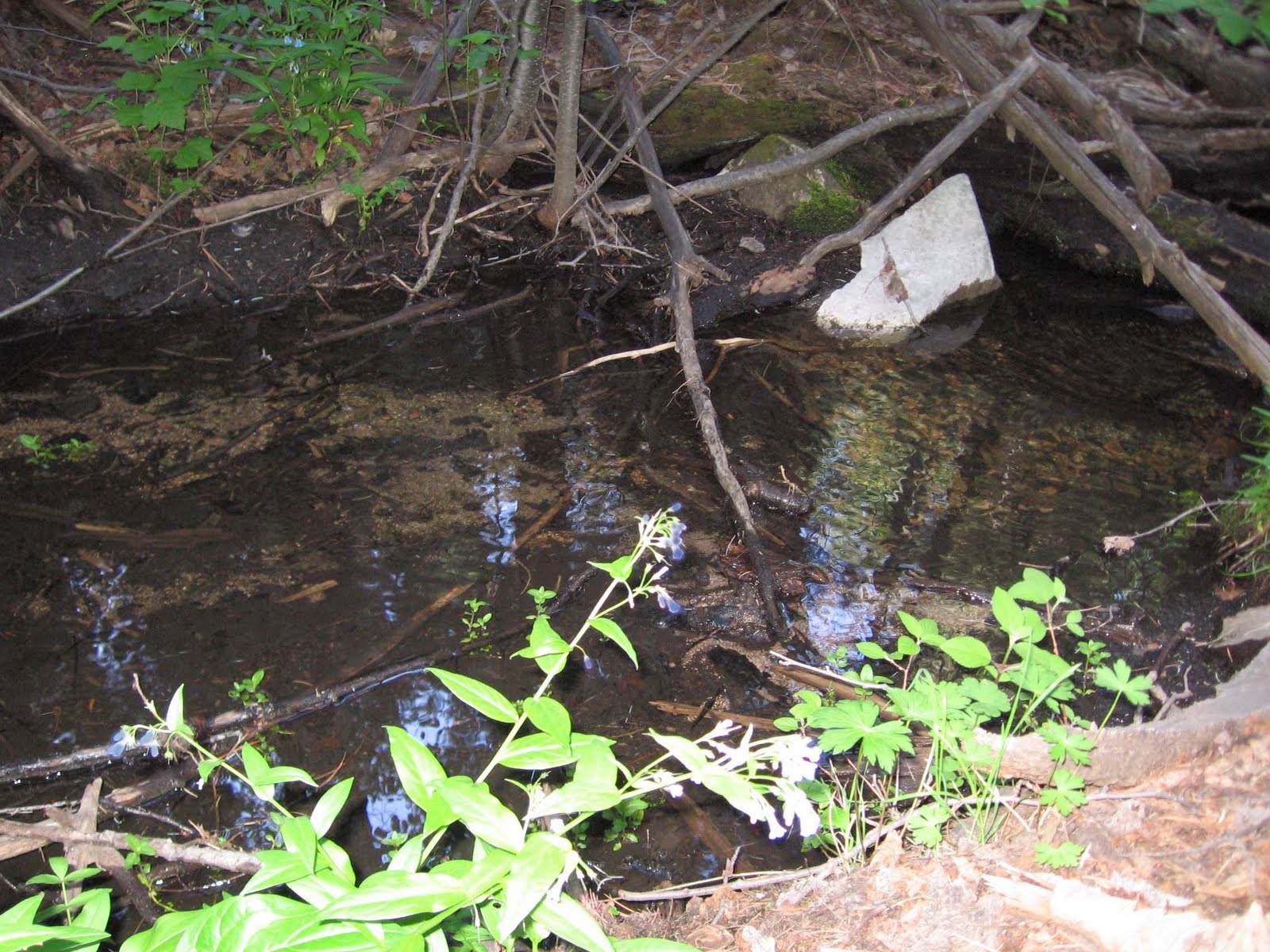
It was a pleasant place to be led to. It had everything a doe and fawn require: water, food, and dense cover. That last item can be hard to find in the Southwest.
In order to better appreciate summer, I took my camera along to record what inspires me. Deer, of course. I follow them even when I am not trying to, or trying not to. But deer are for all seasons. I find magic in snow, but there is inspiration in summer. Here's a shortlist, all shot this morning.
Mountains, and a certain summer color of sky. Sam Scott, whose artwork and writing you should know if you don't, taught me that the eye sees the three primary colors, and, when one is absent, adds it. He talks of seasonal color palettes. On late spring/almost summer mornings like today, the eye adds a hint of red/magenta along the ridgetops.
Flora.
Animal homes.
Land art created by the elements.
This lightning-killed tree is a painting waiting to happen. It's also a home to more living beings than it was when it was alive.
I was thinking yesterday about monumental land art like Spiral Jetty, corn mazes, etc. While there is something there to appreciate, they are monuments to ego, as is, perhaps, all art that is not temporary. When land art is created by the elements, it is without ego. Perhaps that's the definition of magical. But then my eye sees it, and I want to recreate it as a painting, a monument to my ego. Ha!
Friday, June 11, 2010
Rabbits
After a 5-week hiatus from running and walking, due to a strange little injury, I went out early this morning for a hike. It was glorious (before the 95 degree heat). I revisited one of the waterfalls pictured in my last post, now dry.
There is still a trickle of water in Bear Canyon. As I walked through tall grasses next to a stream, a baby rabbit stopped in its tracks. I did the same, and sat down. There we were for 20 minutes, joined by a horned lizard and a white butterfly. At first, the rabbit demonstrated its skill at appearing less and less visible without moving a muscle. It appeared to melt into the earth. Then it relaxed and started eating grass.
The last rabbit I saw stood beside a road, dazed, with a huge bloody eye, likely slashed by a raptor. I picked it up and drove for an hour to the wildlife hospital, where, the last I heard, it was recovering. Raptors occasionally blind their prey before the kill. That rabbit's eye has been in my dreams and waking mind ever since. It was invigorating to see a young, healthy, two-eyed rabbit, and lovely to spend twenty minutes with it.
Sooner or later, a one-eyed rabbit will appear in one of my paintings, perhaps only in a form recognizable to me, and perhaps in the company of a rabbit kit, a horned lizard, and a white butterfly.
There is still a trickle of water in Bear Canyon. As I walked through tall grasses next to a stream, a baby rabbit stopped in its tracks. I did the same, and sat down. There we were for 20 minutes, joined by a horned lizard and a white butterfly. At first, the rabbit demonstrated its skill at appearing less and less visible without moving a muscle. It appeared to melt into the earth. Then it relaxed and started eating grass.
The last rabbit I saw stood beside a road, dazed, with a huge bloody eye, likely slashed by a raptor. I picked it up and drove for an hour to the wildlife hospital, where, the last I heard, it was recovering. Raptors occasionally blind their prey before the kill. That rabbit's eye has been in my dreams and waking mind ever since. It was invigorating to see a young, healthy, two-eyed rabbit, and lovely to spend twenty minutes with it.
Sooner or later, a one-eyed rabbit will appear in one of my paintings, perhaps only in a form recognizable to me, and perhaps in the company of a rabbit kit, a horned lizard, and a white butterfly.
Subscribe to:
Posts (Atom)