Tuesday, December 1, 2009

New work


I enjoyed another great run up Picacho in a little bit of snow this morning. The deer are in their rutting season, which means that the bucks are running themselves ragged. Lots of new deer tracks in the snow, mostly bucks (they drag their hooves slightly, which shows up only in snowy tracks).  All of the deer in the area went into hiding for several weeks when a mountain lion made its presence known, and I missed seeing them. I haven't seen new lion tracks in a week or more, and I hope it has moved on.  All of the deer bones and hair I used in the artwork above were gathered from a single site, just outside a mountain lion's denning area, not far from Picacho.

The exposed deer bones recreate the feelings of discovery and impermanence that arise when I come across bones and other reminders of the daily survival struggles of wildlife. These paintings are tableaus of the marks and signs that represent what we can know about wildlife. The rest is imagination. This morning I came across the marks of a bobcat tracking deer. They don't usually do this, because adult deer are too formidable a prey for them. There was a single spot of blood in the snow. It did not come from the bobcat's paw, nor was there any sign of a kill. It held but did not divulge a narrative.

Now—must get back to the studio.
    

Monday, November 16, 2009

Texas Road Trip

I just returned from a road trip to Dallas. I wanted to check out the art scene there & look up a few friends along the way. It was 20° here in Santa Fe this morning. Finally, some season-appropriate weather. We received only a few flakes from the storm that hit Colorado, our ski basin a few inches. This morning I ran up Picacho and shot the photo below.

I followed a bobcat’s tracks all the way up. It skipped the bends in the disused trail & opted for the most efficient route, as predators always do. I was trying to burn as many calories as I could stand, and the cat was trying to conserve as many calories as possible.

The plains between here and Dallas are a landscape transformed by human appetite.


There were beef cattle and feed lots, fields of wind turbines (not to be confused with the old prototype windmill above), grasslands grazed to the bone, and perhaps not as many oil wells as there used to be. The preferred site for wind turbine fields seems to be mesa tops. When environmentalists advocated for wind power a decade ago, I don’t think they had in mind the grids of sonic booming, bird and wildlife-killing monoliths that are now more common than cotton fields and cattle in West Texas. Why and how they are killing wildlife other than the obviously unfortunate birds who are sucked in is not yet understood. As long as we continue to consume electricity at our present rate, however, we can’t really complain about wind turbines. At least they are not coal-fired or nuclear plants.

The road to Dallas is populated by few people, many decaying industrial forms and abandoned structures, and a collection of small towns that seem to be hanging on by the skin of their teeth. When I lived for four years in West Texas, I hated the place, largely because there was no public land, which made me feel like a rat in a cage, and because it is overrun with Republicans and fundamentalists.


On my first trip back in ten years, I was struck by the beauty of the expansive vistas and disintegrating human-built structures. They seeded themselves in my creative imagination and have already begun blossoming.

Night Spirit, West Texas / watercolor / 8 x 10 inches

84 South / watercolor / 8x 10 inches
I am fairly bursting with the desire to get back to some big oil paintings. As soon as I finish matting a stack of watercolors that will accompany me to a museum show in Indianapolis in 2.5 weeks. . .

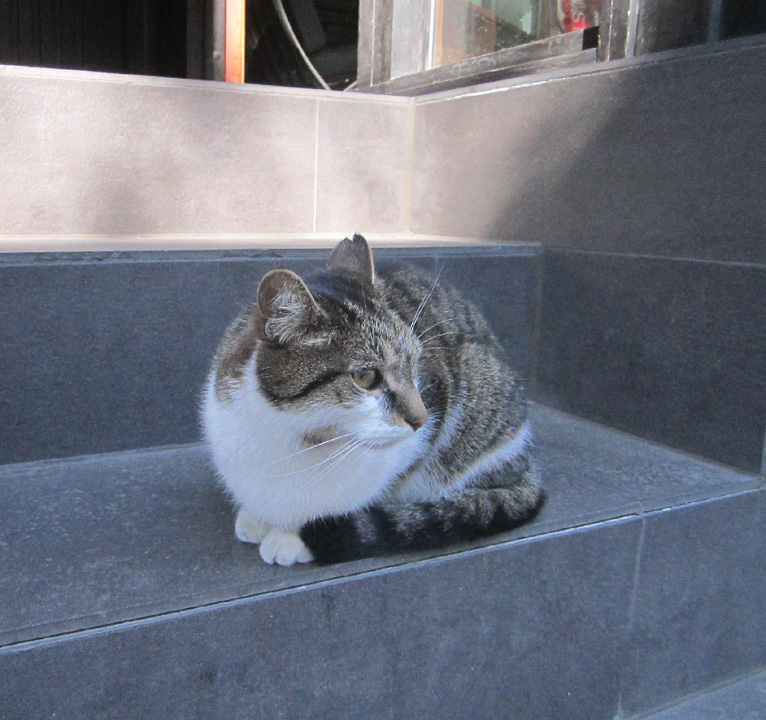
We spent a night with our friend Bruno and his fabulous cat Hermes in Ransom Canyon, an oasis near Lubbock that is home to a steel house built by the recently deceased Robert Bruno (name similarity coincidental). It juts out like a hawk’s eye over the suburban landscape of the canyon.

The Dallas are scene may be small, but it is vibrant. I visited only galleries that show contemporary abstract work, and I spoke with some energetic and friendly people.  Nearly all of the artwork was organic in design, content, and often media. Things were growing in these paintings and sculptures. Artists were overlaying topo maps with personal visual mythologies (something I do from time to time) and creating sculptural forms that spoke of plant life and undersea worlds.

The standout was a piece at Dunn and Brown Contemporary comprised of plant material molded into human skull forms hung in a grid, with a map identifying the plant material (rose petals, mustard seeds, etc.) each skull was made of.  Unfortunately, I didn’t get the artist’s name & couldn’t find it on their website. Galleries of interest include HCG, Craighead Green, Conduit, and DeCorazon. In this steel and concrete desert, galleries are selling, and presumably collectors are buying, portals through which viewers may touch down itno nature and psyche (which are one and the same). Returning via the feedlots and oil fields, I found this reassuring.

As we reentered New Mexico, a storm front blew in from the north.

Friday, November 6, 2009

Morning Run

Out running this morning, I was contemplating what sort of consciousness trees, rocks, mountains, and streams possess.  I've no doubt they do.  Many ancient and contemporary thinkers have taken this one on.  I recently read that contemporary physics has now figured out that rocks have consciousness.  Mountains are aggregates of rocks.  Every mountain seems to have a personality and consciousness of its own.  Yesterday, I was grieving for mountains that are subject to the corporate mining practice of mountain top removal.  Today I'm celebrating whole mountains.  Here's a little photo essay of my run.  I run in a different place every day.  This route is one of my favorites.     

Heading up.  I always like to go up, especially at the beginning.  Pond and beaver dam at center.
Sandia Mountains, 60 miles south, in background.

Thompson Peak, Santa Fe River

Thompson Peak, looming large & ghostly in the early morning light.

Atalaya Mountain.  The ashes of my parents are up there!  Hi Mom & Dad.

360-degree mountains.  Looking west: the Jemez.
 
East/southeast: Picacho Peak.

Thompson Peak again.  It's the mountain I'm standing on top of in the photo at the top of this blog.  I love it because it's hard to get to & out of the way.

 
Down off the ridge now & running along a stream on the valley floor.  This rock is huge, and a bear moved it looking for tasty bugs to eat.  Hello bears!

 
A small animal abode.   I'll learn what kind of animal when I run by this tree in the snow (soon, I hope) and see its tracks.
`

One of my favorite pieces of naturally ocurring rock art.  A painting waiting to happen.
 
Stream bed.  Right now it's a trickle, but in the spring it's a raging waterfall.  On the south-facing hill above it, a man has been living in the open air for years, with minimal possessions--not even a tent.  He's the only person I ever see out here.  I think about his grit & love of solitude.  He's chosen a nice spot.
                                      
Almost back to my starting point.  Chamisa in the foreground, piƱon in the back.  Three ponderosa pines.
                                       
Deer tracks beneath an apple tree that appears to have seeded itself and grown wild.  It's a magnet for deer, bears, and everything smaller.
                                      
Almost back to the field where I started, and where I saw a bobcat last week and a doe and fawn all summer.  Picacho peak behind the cottonwoods in their fall colors.

Sunday, November 1, 2009

Ravens, Red-Tailed Hawks, & Coyote Sightings


We are enjoying a warm spell. Blue skies, gentle temperatures, and soft warm autumn light. I took two eight year old girls hiking, to a frozen waterfall on Two Doe Mountain. I like to name mountains that are not named on maps. My paintings are sort of like that—visual descriptions of unnamed territory, or maps of places on maps that I have intentionally not visited.

The raven in the photograph above posed, talking to me, on the roof of Evergreen Lodge in Hyde State Park, where we began our hike. A few seconds later, I snapped this shot.


The only sound better than a raven’s lecture is the noise of its wings beating overhead. No other bird flies with that rhythmic, beating, breathy sound.  I'd like to reproduce the essence of that sound in a painting.  I've a feeling that the image above will appear in a painting soon.  Ravens and trees, particularly aspen and ponderosa pine, have been commanding my attention of late.

Last weekend, as we were driving down our street, my kids and I saw an ascending red-tailed hawk drop a large rodent to its death. In the flash of a second, the rodent fell with the autumn leaves kicked up by a sudden gust of wind. Our brains were a little slower. It took us a moment to process what we’d seen.

I found the skeletal remains of two deer in the forest last week. I’ve noticed a lot of coyote tracks in that area recently. I wondered whether coyote predation on the deer was increasing or my ability to spot bones on the forest floor was improving. Thursday night, over beer & pizza, I was telling a friend that I hadn’t seen a coyote in months, though I know they are numerous in my neighborhood. Friday morning we saw two, as I was driving Carmen to school, in an open brushy area on my street. They paused briefly and looked us over. They looked big and healthy. I though of my fat, white, brain damaged cat, and hoped she had heeded my advice to stay in the fenced back yard. Reminders that nature is red in tooth in claw, and life brief and precious, abound. It’s a theme that surfaces in many of my paintings.

Tuesday, October 27, 2009

Bobcats & Mountain Lions: Living With Predators


I went for a run this morning in the rugged hills northeast of Santa Fe. Gnarly and dry as these hills look, they conceal narrow canyons with running streams like the one I photographed above.

There is snow on the mountains, and more on the way. I was looking for signs this morning that the mule deer are making their way down to their winter territory. I saw only a few fresh tracks. At the end of my run, just across the street from the Randall Davey Audubon Center & Sanctuary, I saw a bobcat leaping above the two-foot high grasses; all four paws off the ground, four legs stretched straight out.

I have seen only two other bobcats, both of them within a couple of miles of the Audubon Center, one dead, the other disappearing into heavy brush. This one, floating above the grasses, with autumn foliage in the background, was stunningly beautiful. Now I know why I haven't seen the doe and fawn, who have been hanging out in the same bushy area all summer, in a month. A bobcat has moved in.

I saw a mountain lion, my 7th, in the same area a month ago.  It exploded out from its place of concealment a few yards away from me and was gone almost before I realized what it was.  I guessed that it might have been a youth.  It was not as large as the others I have seen, and I doubt that a mature mountain lion would have betrayed its hiding place only to run off in apparent confusion.   

When I see these beautiful predators, I feel conflicted. I feel fear for the deer I've gotten to know in the area, and I know that the predators need to be there in order for the deer herds to stay healthy. I'm glad there are places where big predators still roam. I’m glad that I live in one of those places.


Wednesday, October 21, 2009

First Snow


Rain for almost 20 hours, and now snow. The only thing better than rain here in the high alpine desert is snow. Carmen and I have declared the first snow an annual holiday. She’s at school today enjoying hot chocolate & pumpkin carving with her fabulous teacher. Here’s a poem I wrote six years ago on the occasion of the first snow. It makes for great light in my studio.


First Snow

The first snow coming in from the West
extinguishes the lights of the city

We can’t see further than across the street
Carmen worries that our city won’t return
I wish it wouldn’t
We can’t see the coyotes padding softly
on their nightly mission
the bears up in the watershed, agitated by hunger
stupefied by the urge toward sleep
We can’t hear traffic sirens the band down at El Farol

Here in the cradle of the storm
There’s nothing but snow and wind
A wavelike rhythm, now to the East now to the West
and breath

Silver light, cloud-refracted
beams in through water-laced glass
I lie in bed trying to recall the last time I lay in love’s embrace
I recall the last four years’ first snows
where I was, what I drank, ate, nature of conversation, with whom, quality of light, nature of snow
Do I miss the embrace I can’t remember
the touch that left less
of an impression upon my skin than the texture and water content of snow?

Like Carmen misses the city she can’t see

Years ago my Spanish teacher translated “to miss”
echar de menos
“to be struck by the lack of”

I’m struck by the lack of an embrace I can’t recall
by the years between me and a caress that conveyed
not ownership nor need nor desire, but something else

The storm moves East
The city returns intermittently
Ice crystals whip the streetlamp’s now softened haze
Carmen, in dinosaur pajamas, breathes deeply

Between warm sheets the urge toward sleep
stupefies with the softness of cloudlight
Who could embrace me like all of this?

A question, struck by the lack of an answer

Monday, October 19, 2009

Running off-piste


I painted this watercolor a month or so ago. Title: Above Sunflower Falls: Fawn Nursery, 12 x 9 inches. I've been running all summer in an area occupied by a group of does and their fawns. Now the time is approaching when the bucks rejoin the doe and yearling groups and they head to lower ground. October is the gentlest month, and it's been a warm one here in the Sangre de Cristo Mountains. This morning I ran up Picacho and saw a doe and her fawn. The fawns have reached a good size in this gentle autumn, and there is still plenty for them to eat. Picacho's summit is at 8,577 feet. It's a steep but accessible and short climb, 49 minutes up and 26 minutes down, if you run slowly, like I do.


I took a little-used, half-hidden trail. I usually avoid trails, perhaps because I’ve been shot at three times over the years by strangers while running on trails. That’s life in America, where everyone is armed to the teeth and proud of it. Fortunately for me, all of my assailants had bad aim and/or were drunk, and I was never hit. Armed drunks aside, I prefer finding my way off-piste.  I like to use map and compass, sight lines and intuition. There is much to be said for aimless wandering. People who study deer report that their movements are unpredictable, as though they decide from one moment to the next where they are going.  If you don’t know where you are going, neither does the mountain lion or drunken hunter. Aimless wandering cuts down on thinking and fosters a different kind of consciousness.


Pregnant Atop Picacho, 2001